|
A Reader's Guide
How the Other Half Lives… and DiesExploring the hidden equilibriums of an hourglass soap film called a catenoid Make a virtual soap-film catenoid at: 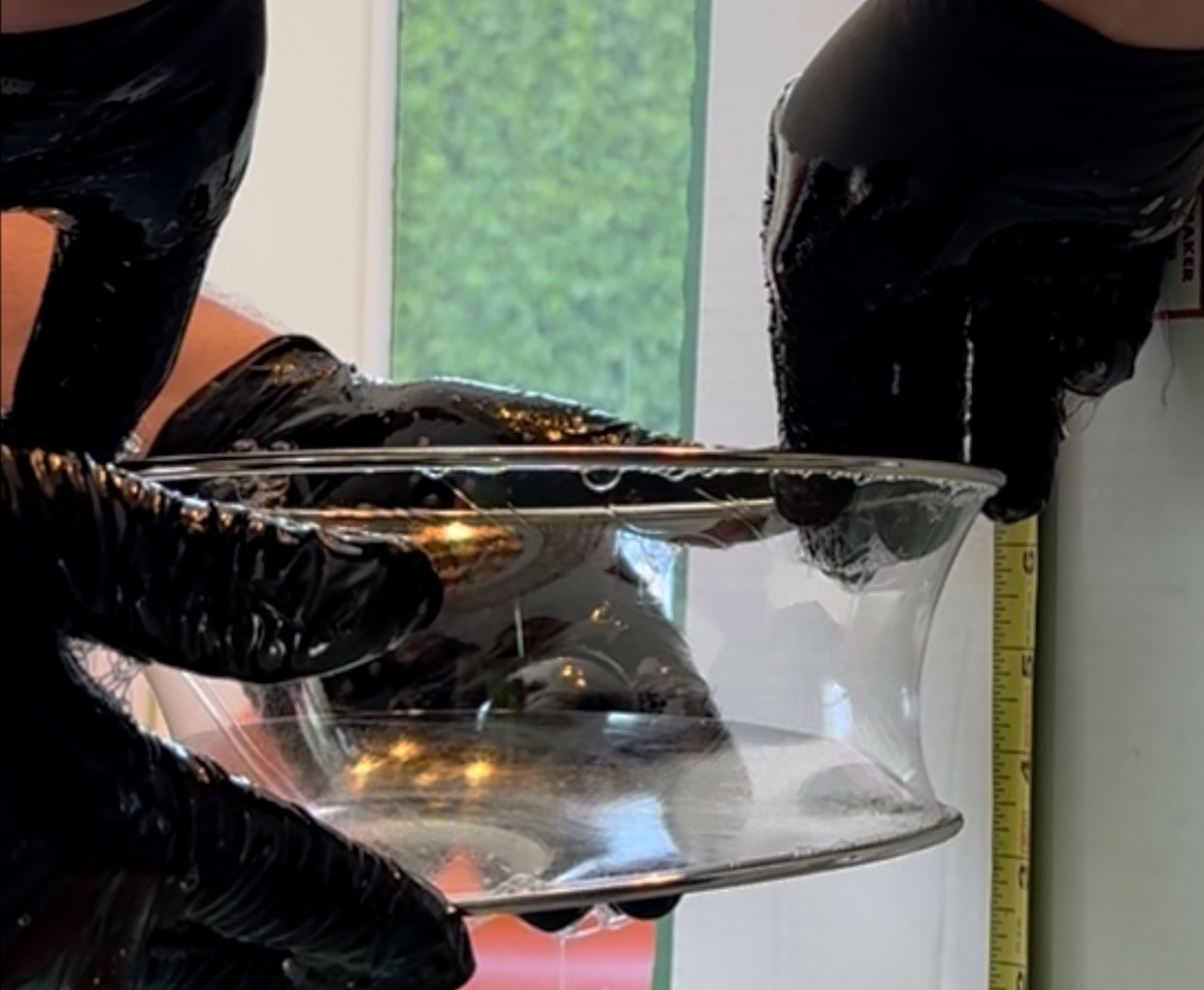
Dip two wire rings into a strong bubble-making solution, press the rings together, and pull them slowly and evenly apart.1 A soap film connecting the edges of the rings will form, hollow in the middle. Keep pulling the rings apart and the soap film will take on an hourglass shape called a catenoid. Keep pulling and the hourglass-shaped catenoid will get narrower and narrower at the waist, until ultimately, it pops. On popping, the soap film snaps back and re-forms as two flat disks, one filling each ring, with the rest dissipating as part of the pop. A home-testable experiment in hidden equilibriums. This reader's guide explains why:
1
One ruleSo long as it holds together, a soap film follows a single rule: spend less. Every bit of soap film costs energy, so whenever the soap film can reduce the bill, it will. At rest, soap film settles toward the least surface area available to it from where it already is. Those giant soap films you see in shows are not at rest; they are in the midst of being transformed. But once a soap film settles, it follows the same rule, subject to whatever is holding its edges or trapping its air. One clarification before we start: we are not talking about "bubbles." This is a soap film, not a bubble. The soap film we are discussing is a circular wall of professional bubble maker's solution, hung between two eight-inch wire rings and lifted out like an empty can. There is no skin of soap across the top or bottom ring as the rings get pulled apart; air passes freely through the middle of the ringed soap film wall.3 2
The chain hiding in the soap filmHang a necklace loosely between two fingers and it curves. That curve is the same every time, for every chain: a necklace, a jump rope, the cables between utility poles. Gravity pulls each link straight down, and the chain's tension runs along its length. The chain is evidence that the gravity and tension are in balance. It looks like a simple arc, and for a long time people assumed it was the parabola, the curve of a thrown stone. When the mathematics was worked out in the 1690s, it turned out to be a different curve, built from the math of compound interest and doubling.4 The curve was named the catenary, from the Latin word for chain. 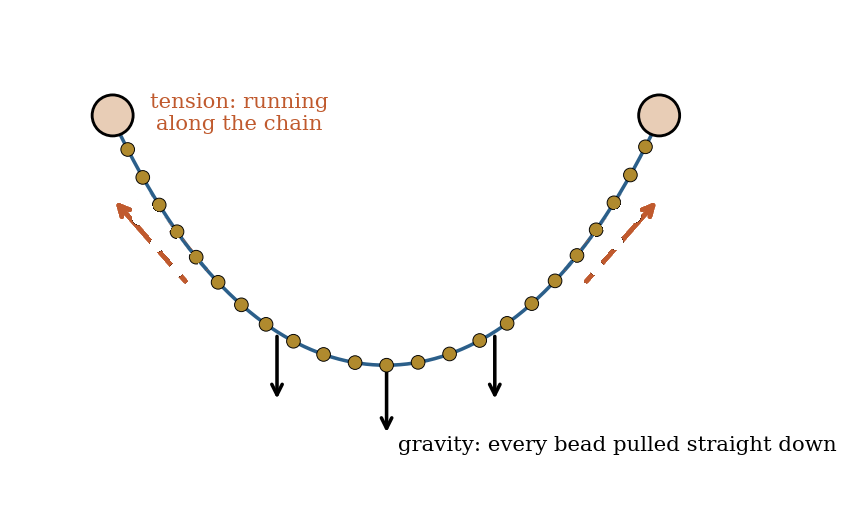
Now the surprise: stretching the soap film between the rings produces the exact same curve, turned on its side, the catenary. That hourglass shape is just the chain curve spun around the center axis of the two rings, which is why it is called a catenoid. Hold a piece of string between two hands and pull it taut. There's no curve, just a straight line. But, feed in a little slack: a gentle bow appears. Feed in more: the bow deepens and steepens. Every one of those bows is the same curve, the catenary curve. Turn a shallow-bow chain curve on its side a quarter turn, and you are looking at one of the hourglass waist profiles for the hollow soap film between the two rings. That's the outside of the hourglass catenoid. The interior circle where the soap film tucks in the most is the catenoid's waist. The indent is how deep that waist tucks in, measured from the straight line you could draw between the two rims. Measure straight across the catenoid and you cross two indents, one on each side, with the waist across in the middle. If the walls ran straight down like a can, the waist across would equal the full ring width; instead the walls bow in, and that bow is what the two indents record. Two indents plus the waist across always rebuild the full ring width; the geometry only redistributes it. Keep that audit in your pocket for the end of this guide. 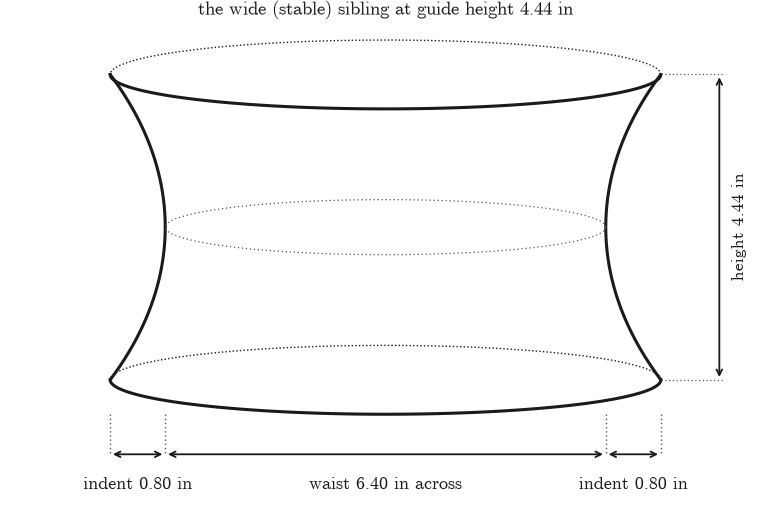
If you want to know how the hourglass catenoid's indent works, it is as simple as hanging a string between two posts eight inches apart with eyelets at the top. When you pull the string taut, there's no bow; the string spans 8 inches straight across. As you feed in string through the eyelets, you see a replica bow that forms the indent of the hourglass catenoid. 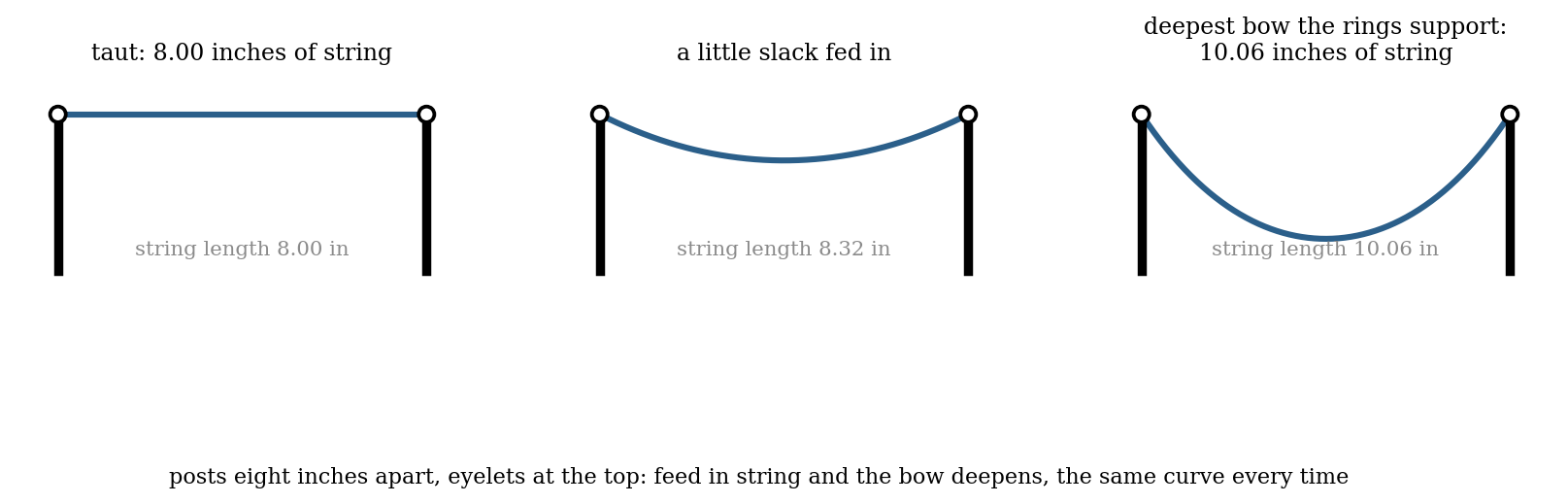
If you keep feeding in string till you have fed in about one inch more from each side, you have about all the bow the indent will carry into the hourglass catenoid. The taut 8.00 inches at touching rings becomes 10.06 inches at the last soap film the rings can support. And the chain keeps a perfect ratio the whole way: its sag divided by its span always equals the soap film's indent divided by its height, because a magnified curve keeps its proportions. Here is the remarkable part: every catenary you will ever see is a window onto one single universal curve. The shallow bow of a nearly taut necklace is a zoomed-in view of its flat bottom. The deep sag of a slack one is a zoomed-out view of its steep walls. Different windows, same curve. And every waist the soap film can wear between the rings is that same curve again, turned on its side and spun. 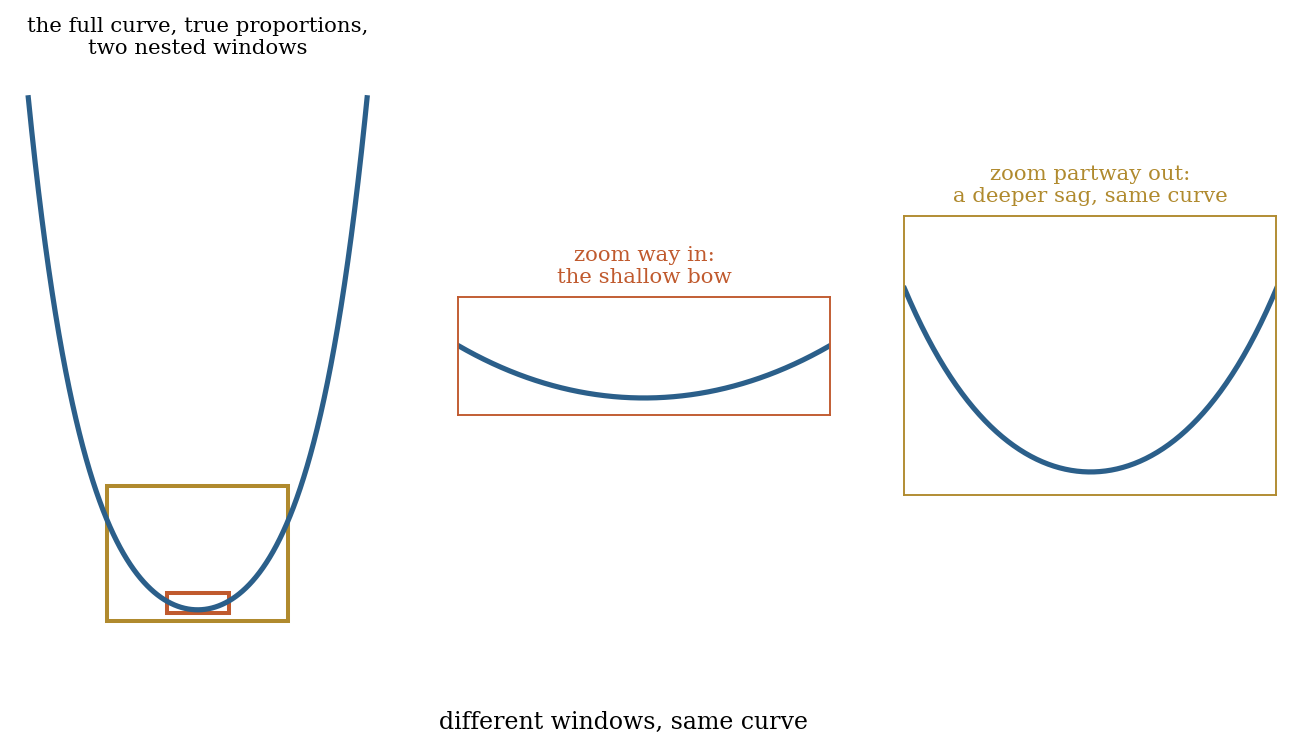
3
The tightened corsetTo some people, the hourglass-shaped catenoid looks like a tightened corset. This despite the soap film not feeling constrained whatsoever from the inward bowing. The catenoid curves in a balanced way, inward in the middle, outward to the rings. Geometrically, more height comes with a deeper inward bow; the corset is a resemblance, not a squeeze. Why does the inward bowing happen at the middle and not the top or bottom? Anchoring. The top and bottom edges of the soap film are stuck to rigid wire rings, so those circles cannot shrink. Every horizontal loop of soap film between them is free to pull inward. And because the two rings are equal and evenly placed, the deepest pinch lands exactly halfway between them. Think of a clothesline loaded evenly along its length: it sags most at midspan, the point farthest from both posts. The soap film is the same picture turned sideways: the wire rings play the posts, and the waist is midspan. Gravity shapes the clothesline; surface tension shapes the soap film. The loads differ, but both balance laws produce the same curve. That is why the hourglass's side profile is the hanging chain's curve: the same curve, wearing different clothes. The catenary solved the problem once; the spun catenary, the catenoid, obeys the same rule in 3D. 4
The raceWhen you pull the rings apart, two effects compete inside the soap film's geometry. The first competitor comes from height, and it is easy to see: the rings are farther apart, so the soap film has farther to reach. Count the height in waist-widths, and each added unit of height adds one more unit to the reach. A straight line on a graph. Mathematicians call this linear growth. The second competitor is the corset's middle bowing inward: the waist pinching deeper. This one compounds, just like the math for the bowing necklace. 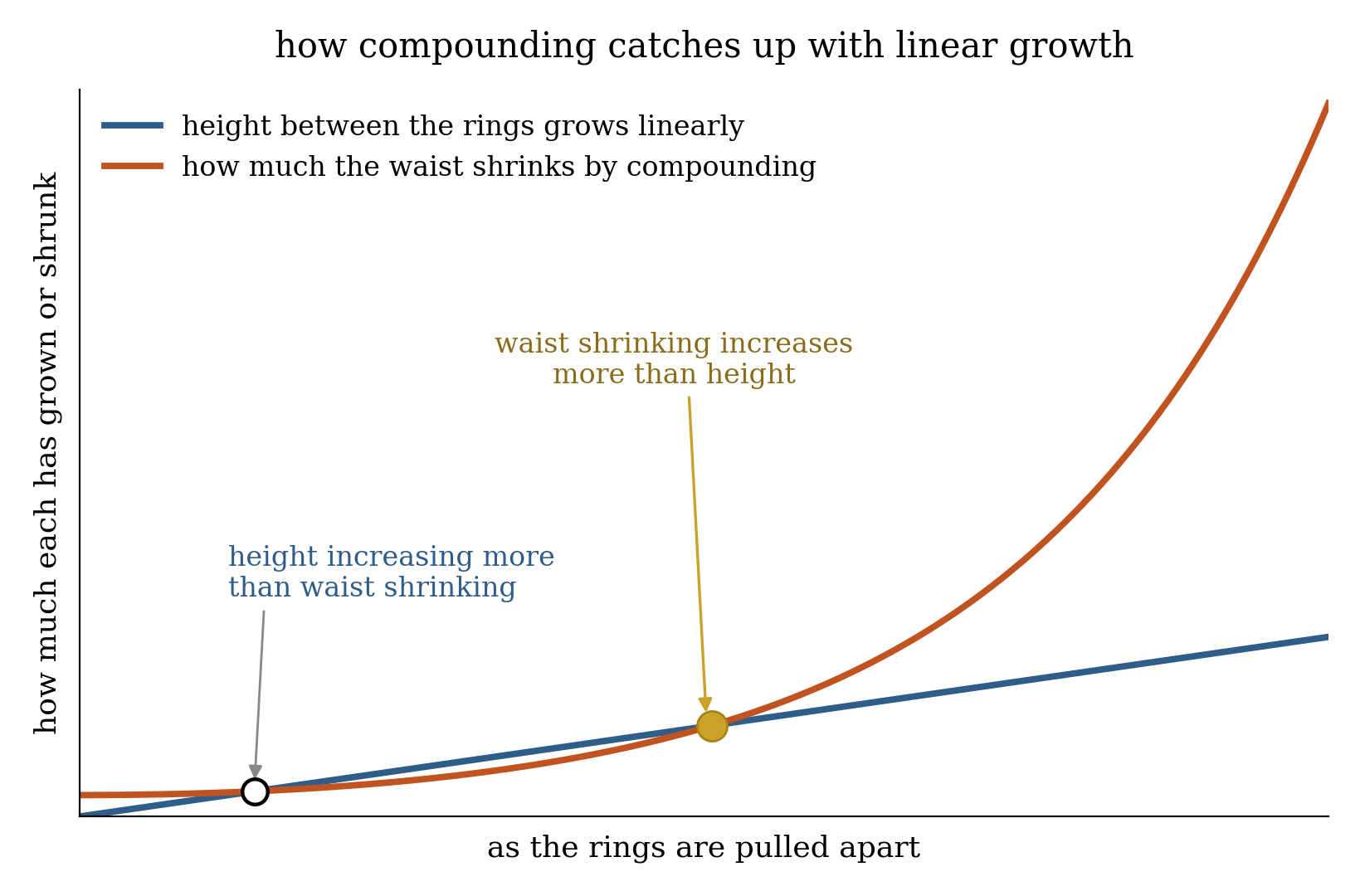
So, when you are lifting the rings apart, the soap film pinches inward, and the two competitors both press their claims. The height you win by pulling the rings apart is the straight-line side of the race. The bowing that pays for it is the compounding side. As you separate the rings farther, that continues to put pressure on the middle: a deeper pinch must come with a smaller waist. And the waist does not shrink by the same amount each time. Each deeper pinch makes the next pinch more costly, so the pinching ramps up quickly. At first, the trade is worth it: a little more pinch gives the soap film a longer useful curve, so it can span the rings farther apart. But each added pinch buys less reach than the one before, and the waist keeps narrowing to pay for it. Eventually the narrowing costs more than the extra reach is worth. What matches at the turning point is their relative growth, not the values of the two curves. That is why the turning point sits at a fixed ratio of ring size to height, the same for any pair of equal rings, whatever their size. This race comes with a pre-built deadline: past that ratio, no amount of pinch buys the soap film enough reach to span the rings at all. 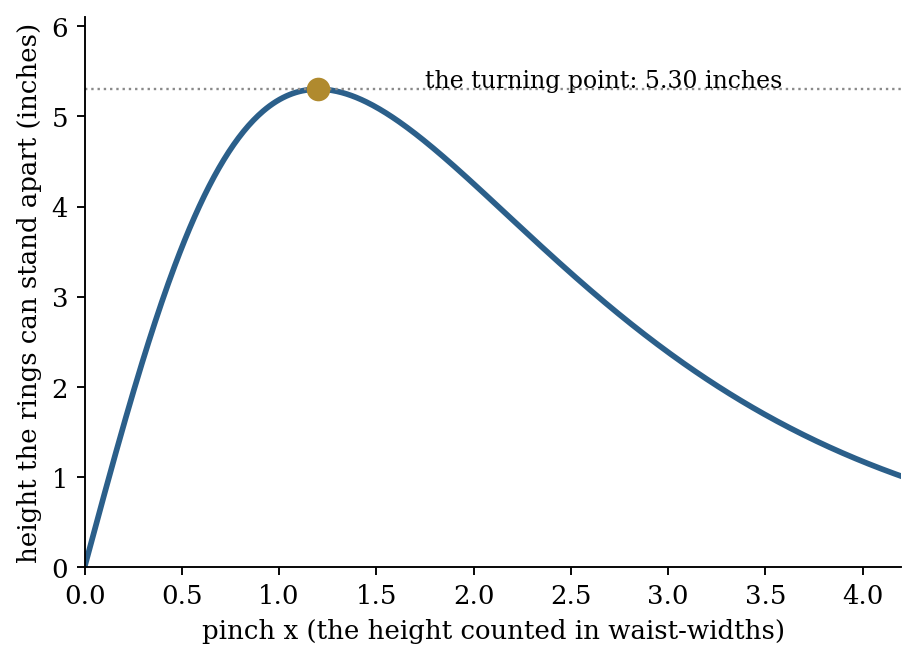
5
The thrown ballThe peak of a thrown ball creates a strange and lovely consequence. Toss a ball up twelve feet and ask: when is the ball at ten feet? There are two answers: once on the way up, and once on the way down. Ask the same question at any higher mark short of twelve feet and you still get two answers, moving closer together as you move higher. Ask about the exact top of the throw, twelve feet, and the two answers become one. Ask about anything higher, like, “When is the ball at thirteen feet?” and the answer is: never. The soap film operates the same way. When you separate the rings, a fair question is: what waist of the catenoid can balance at this height? For every positive height below the peak, there are two answers. Wait, what? I only ever see one. You are not wrong. The one we see is the stable, wide-waisted hourglass corset catenoid getting pinched as it stretches. It's the hero image. In the ordinary two-ring experiment, it is the only catenoid you will likely ever see. But, there is another. Instead of the well-known, wide-waisted, gentle hourglass bowing in, getting snugly laced like a corset, that we always see, there's a mathematical sibling! It is the wide sibling in opposite land. As the rings are pulled apart, there is more relief for this slim-waisted sibling, its waist growing looser and wider. To make comparison easy, we'll use an index based on 100 instead of the exact surface area. 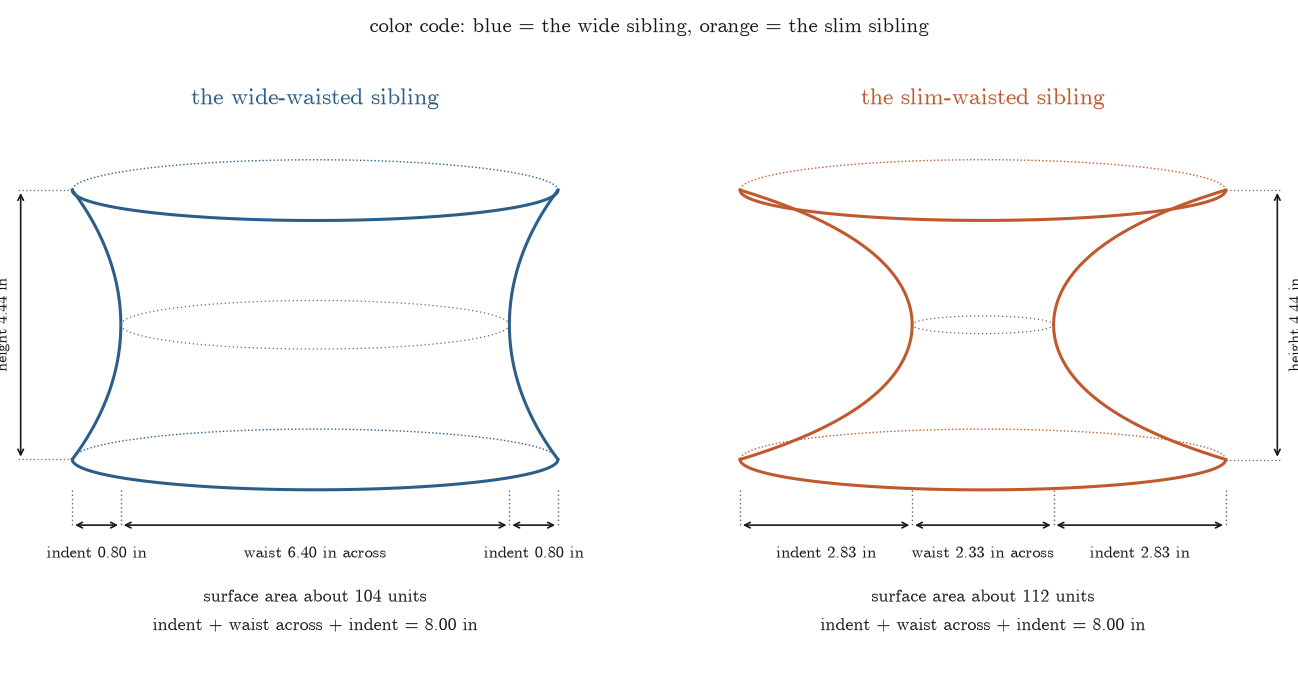
Both waisted catenoid siblings are genuinely balanced. At a height of about 4.44 inches on eight-inch rings, the wide sibling's waist is about eighty percent of the ring width (6.4 inches across), while the slim sibling's waist is about twenty-nine percent (2.3 inches across). You would hardly know these two were siblings given how opposite they look. The soap film normally wears the loose, wide-waisted corset, because that shape spends the least surface area among the nearby shapes it can reach. The slim catenoid spends more surface area, even though it too is in true balance. But, remember, these siblings work as mirror images of each other. As you pull the rings apart, the wide-waisted sibling's waist gets constricted, but the slim-waisted sibling's waist gets less constricted. The wide-waisted sibling pinches inward. The slim-waisted sibling opens outward. And, as you would expect with a ball thrown up in the air, these two waists are on a collision course. The final moment at the top of a thrown ball's trajectory is about to play out for the two catenoid siblings. They're about to meet in the middle. That moment is the critical catenoid. 6
The Super Improbable Super Slim SiblingI know what some of you are thinking. But heads or tails is not the complete list. A coin can also land balanced on its edge, and being improbable does not erase it from the allowed landings. An honest inventory counts it. The slim-waisted catenoid is a necessary member of the universe of possible ways a catenoid can be, no matter how unlikely. Just because the slim sibling's existence as the catenoid is first pulled up is wildly more precarious than a coin landing on edge, it doesn't mean it doesn't exist. 7
Expandable lawn chairs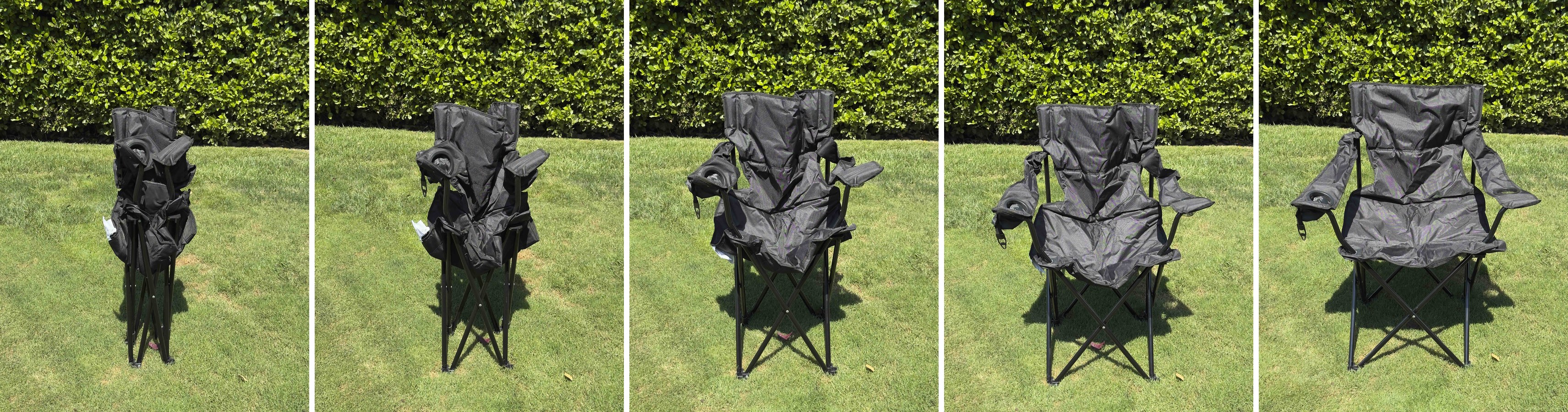
This is an expandable lawn chair. Put a ping pong ball in the fabric where the seat would be, while it is collapsed, like the chair on the left, and that ping pong ball will have a really hard time escaping. It's in a basin. The deep catenary walls, like an elongated necklace, form a basin that is hard to escape. (The chair is an energy metaphor, not meant to represent a soap film's fabric.) Now, expand the lawn chair slowly with the ping pong ball still in the fabric chasm that will become the seat. As you move left to right and spread the posts, the seat fabric becomes flatter and flatter. As the seat gets flatter, the basin that protects a ping pong ball from leaving the seat gets weaker. This is the world of the wide-waisted ping pong ball. It sits in the dip and has a tough time escaping that dip. 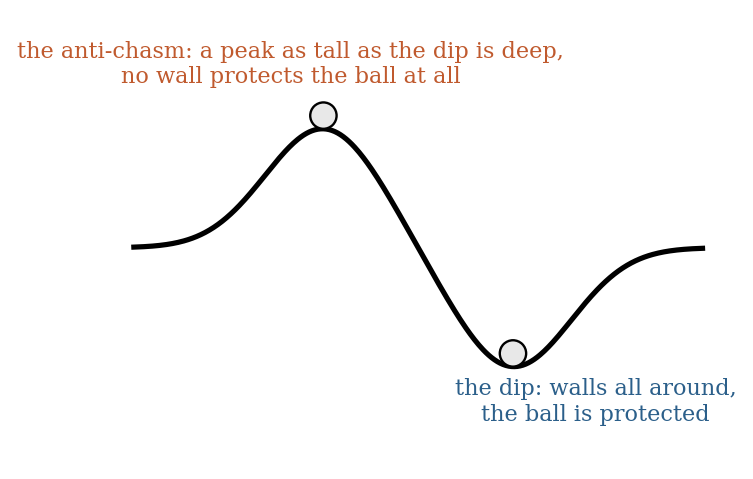
The world of the slim-waisted ping pong ball is exactly where you'd expect: not in a dip, but on top of a neighboring peak. You may be saying, this is fantasy. There is no such expandable chair with a peak rising opposite the fabric seat's dip. Well, you're correct in the metaphorical expandable chairs department, but you would be wrong about catenoids. The slim-waisted catenoid's state, for its ping pong ball, is like sitting on the anti-chasm: the peak standing opposite the protected dip. 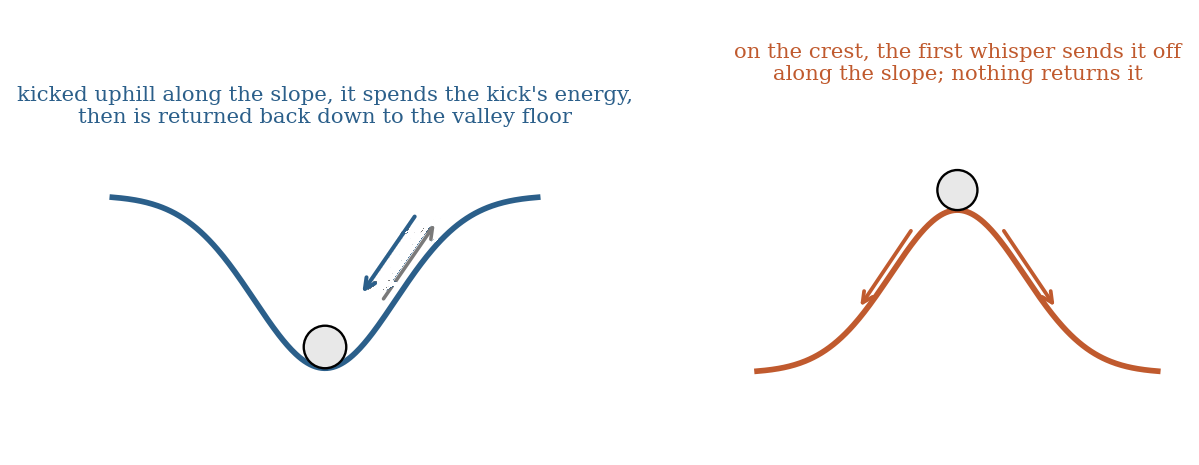
The dip's walls are a real price standing between the ping pong ball and anywhere else. But balance the same ping pong ball on the dip's opposite, the crest, and there is no protection for that ball from falling off the peak. The first whisper of a mosquito sends it tumbling down. Yet, both ping pong balls are balanced, one in a dip, the other balanced precariously on a peak. One is protected from straying from its spot by its basin, one is on the precipice of straying. 8
Equilibrium, stability, and protectionWhich brings up a super good point. Three different questions are hiding under the ordinary word balance. First: does a balance exist at all? Both catenoids answer yes. Second: if you disturb it slightly, does it recover? Only the wide-waisted catenoid recovers from every sufficiently small disturbance, so long as the sheet stays whole and pinned, because it sits at the bottom of a basin. Third: how much protection surrounds that balance? That is what we will call: the toll. This guide keeps those three questions separate because Nature does too. Mathematics splits the word balance accordingly, and now you can see why: the wide-waisted catenoid's formal name is the stable catenoid, and the slim-waisted catenoid's is the unstable catenoid. That word, protection, is the most important word left in this guide. The wide-waisted catenoid is the ping pong ball in the dip: it shrugs off even being knocked around because the dip has high walls. Here is the precise truth about the slim catenoid. Against a pure sideways push or a pure uneven ripple, it springs back, as its wide twin would. Against exactly one motion it has no wall at all: the even squeeze of its waist. And an ordinary nudge is never pure. Almost every bump, draft, and jostle carries at least a little of that squeeze, and any amount of it, however small, fells the slim catenoid. 9
The billFreeze the rings at one height. Instead of asking only which shapes can balance, put a price on every shape. The price for soap films is always surface area. For a soap film, more surface area means more stored energy. To keep the numbers friendly, measure every shape against the one configuration that never changes: two flat disks of soap film, one filling each ring. This guide will call the hourglass setup ring-to-ring, because the soap film spans from one ring across to the other, and the two-disk setup within-rings, because each disk sits flat within its own ring. Given the index of energy we mentioned prior, the within-rings will be our standard. Its surface area is 100.5 sq in, which we'll simplify as 100. For eight-inch rings, using the effective surface tension assumed in the appendix, 100 on this register is the same energy it takes to lift a ten-gram pinky finger about 1.3 inches. Small stakes to us, but the whole world to the soap film. 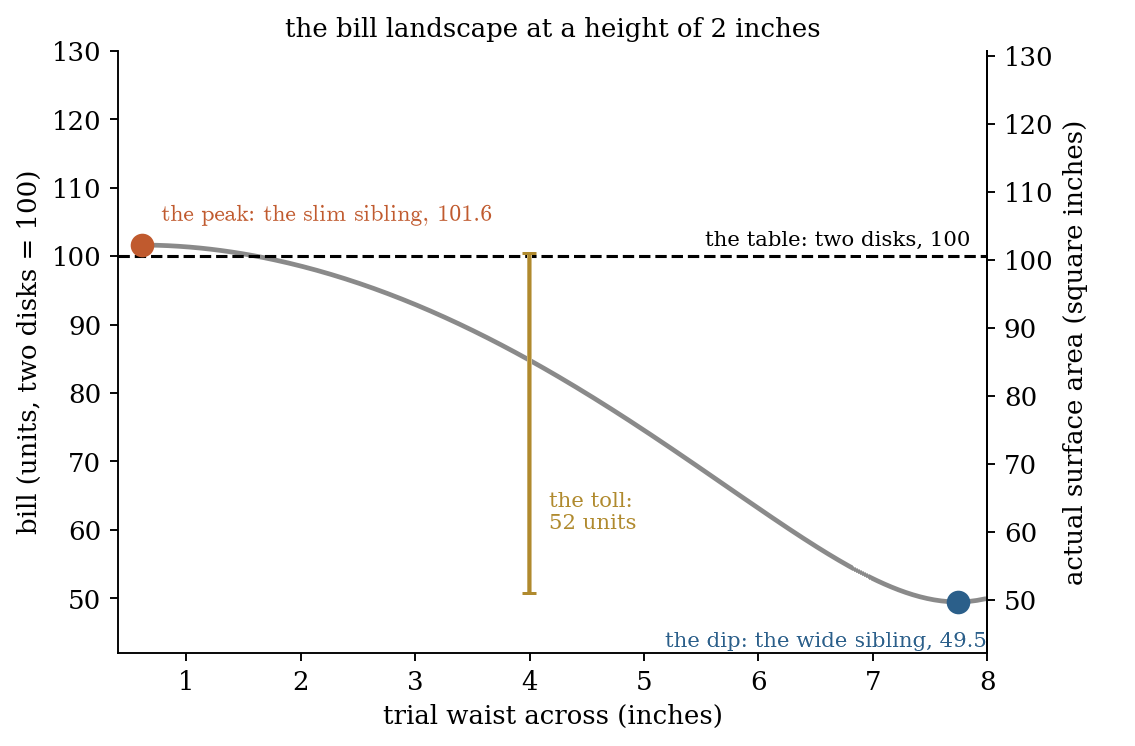
The dip. Remember what height means on this landscape: a taller spot is a waist that stores more energy, because it carries more surface area. In soap film terms, that means higher up is more expensive, and cheap is the only direction a soap film moves. The valley floor is the lowest-energy waist available, and that waist belongs to the wide-waisted catenoid. The ball rests there for the same reason the soap film wears that waist: it is the cheapest place to be. Put yourself in the dip and kick the ball: it climbs a short way up the slope, spends what you lent it, and rolls back to the floor. The soap film behaves the same way. Enough of a kick and it pops; nudge it gently and it only wobbles, then returns to the bottom. That is what stable means. The peak is the same rule with the opposite outcome: the slightest touch sends the ball downhill, and nothing returns it, because the climb home is uphill and the ball doesn't come with a motor. No kick, no energy to climb hills. The slim-waisted catenoid sits at that crest with no way to get back to it if moved. The table. This is the within-rings setup: two flat disks of soap film, one filling each ring, priced at 100. No matter how far apart the rings move, the disks' price never changes: 100. Why? Because the within-rings soap film in the two rings is the same if they are nearby or miles away. 
Here's the part you've already sat in. This landscape is the expandable lawn chair from section 7. Set a table beside it at the exact height of the 100 line. Now expand the chair. The same motion that spreads the frame also flattens the seat, just as the same pull that separates the rings also irons out the soap film's dip. The ping pong ball's dimple gets shallower and shallower as the posts are expanded, until the dip and its neighboring crest fuse into one level spot. The ball keeps its balance exactly there, but there is no basin left around it; the smallest tilt or breath sends it away. Think of the protection like a coin, in this case, an egg-shaped (ellipsoid) coin. A coin lying flat is hard to disturb. The energy to flip it to its edge costs a lot. That climb is the lift, and it is the coin's protection from getting turned over. When you pull the rings apart, the soap film's lift, or the energy to get it to change, adjusts. Pulling the rings apart lowers the lift. Nothing about any single moment is dramatic. The protection of the landscape just quietly drains as you pull the rings apart. That's like the seat's basin disappearing. 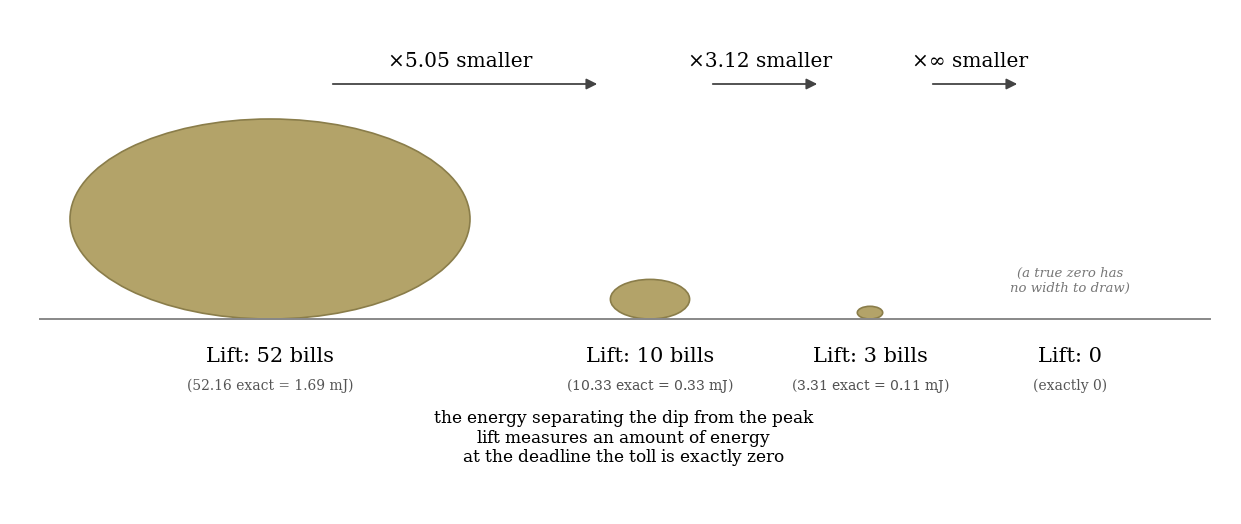
The Fold Explorer at skwedge.org shows this same countdown as a live instrument: park it at any height and it marks the dip, the ridge, and the toll between them, all the way down to zero. Watch the two dots there and you'll see what the chair just showed in fabric: the resting place and the crest sliding toward each other until they touch. 10
The soap film log flumeBelow is the comparison of the two disks, each a bill of 50, or 100, versus the bill of 84.5, for the 3.5-inch hollow catenoid: 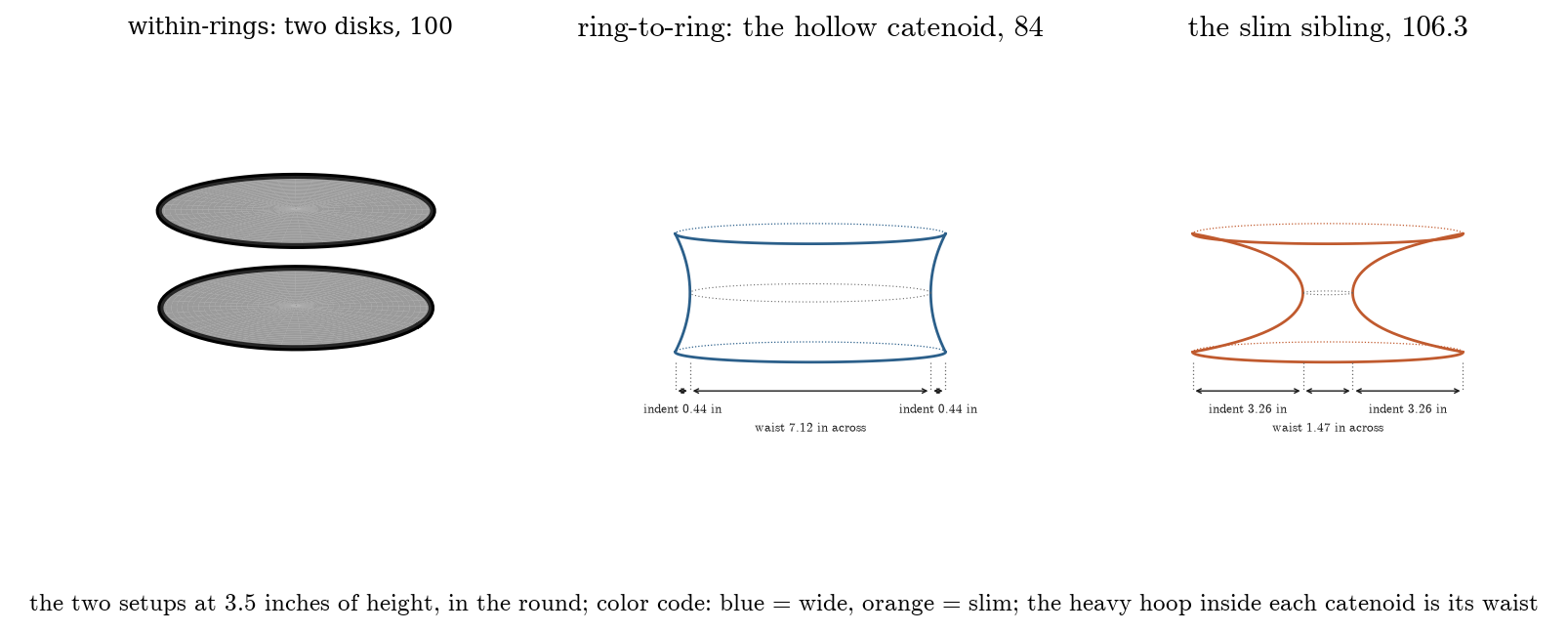
At a height of three and a half inches, the catenoid's bill is 84.5: getting close to the disks' price. Even at 3.5 inches the accounting ties together: the dip sits at 84.5, the disks at 100, and the peak (ridge) just above them at 106.3. The toll is the whole climb, 84.5 up to 106.3: 21.9 units. That is what stability is here: the dip is deep, and every nearby shape costs more. When you pull the catenoid to 4.22 inches tall, an interesting thing happens. At this precise height, the bills tie: the ring-to-ring catenoid's bill is 100 units, and the within-rings disks' bill is 100. The expandable chair shows the energy far below 100 units in its deep dip. Just as the chair expands, the seat and its dip rise, all the while getting closer to the same bill as the two disks' bill of 100 (what we're calling metaphorically, the table). But at this height of 4.22 inches, the catenoid costs the same as the table: 100 units. Past 4.22 inches, now the catenoid costs more than the two disks. The ring-to-ring is now the expensive setup, and within-rings is the cheaper one. Wait, why does the catenoid not go back to the disks then? Well, the catenoid has no eyes and doesn't have a ledger. It's just soap film. Soap film doesn't know about the two disks because its current formation is the catenoid. So, the catenoid stays a catenoid. The reason is not preference; it is the route. To reach the cheaper setup, the soap film's waist would have to ride the log flume to get to the two disks. Well, that peak of the ride is still the most costly thing to do, so the soap film stays put; staying is the smaller bill. 
Think of it as a moving bill with a catch: the movers demand their fee up front, and the soap film cannot borrow against the savings it would enjoy after the move. However cheap the destination, the climb to the ridge must be paid first, out of energy it does not have on hand. The log flume is the symmetric waist route this guide's model walks at that height. Before the catenoid was pulled to 4.22 inches the question never came up, because ring-to-ring was already the cheapest setup in the room. After 4.22 inches, the soap film is living on borrowed time: the cheaper home is over the log flume's peak. That traverse of the flume's peak is the toll. It's why the catenoid cannot simply reapparate to the disks. Well, who is paying for all this energy making the ring-to-ring more expensive? A character who has been offstage the whole time: the hand. On a log flume ride, the motorized track takes one from the dip to the peak. In catenoid-land, it's the hand. The rings do not separate by magic. Something pulls them, and the soap film fights that pull the entire way. And, while pulling up soap film is hard enough to feel, the reason there's feeling at all is the energy you're supplying to build the catenoid. In the ideal slow-pull accounting, the hand's work against that tug is where the rising bill comes from. The hand deposits energy; the soap film banks it as surface energy. By a height of 4.8 inches, the hand has banked nearly four thousandths of a joule in the soap film, almost two pinky lifts, and the toll guarding it has collapsed from 52 units to about 3. Every inch of separation changes the books twice: the hand deposits more surface energy, while the landscape leaves the soap film with less protection. Near the end the protection does not fade gently. Each halving of what remains before the deadline drops the protection to about a third, not a half. The wall is sinking faster than the soap film is approaching it. It's as if some giant were standing above the log flume pulling it so all the peaks and dips were flattened, like the seat fabric of so many expandable chairs. 11
Ways soap films dieSo far, we have covered two possible routes a ping pong ball can exit the expandable chair. Route 1: outside energy. Kick the ball up out of the dip, over its wall, and down the far side of the log flume (hard to do). Route 2: change the landscape. Raise the fabric seat so a ping pong ball ends up with no basin, is on a flat surface, and it has no protection from remaining on the seat. Route one: kick the ping pong ball out of its dip. You have watched this route being attempted your whole life: every time a bubble wobbles, it is being kicked. A draft, a footstep, a jostle arrives, the ball rides partway up the wall, and the wall wins. It wobbles, but it does not collapse. It recovers. That is route one failing, which is almost always. For route one to succeed, the kick has to be bigger than the whole toll in one blow, and while the rings are close and the toll is large, a quiet room supplies nothing remotely that big. Route two: flatten the landscape. Nobody kicks anything. The hand keeps increasing the height, the landscape keeps deforming, the log flume's dip and peak keep getting closer and closer to each other because the climb between them is being pulled flat. In this scenario, the toll to get over the log flume counts down: 52, 10, 3, 0. At zero, the dip and the ridge have merged, so the wall between home and escape is gone: the energy required is none. Keep pulling even a hair further and no resting place remains at all; the ball leaves without ever being touched, because there is nothing left for it to rest in. Real soap-film demonstrations can showcase what a catenoid is like, but only math is the perfect clean room. Without such a clean room in the real world, most soap films perish due to route three. Route three
The real-life exit, and what actually happened in my photographsA real liquid soap film suffers the real world, not math, for most of its exits. Soap films rip. Drainage, evaporation, dust, or a stray defect can thin the sheet until a hole opens, and a hole changes what the soap film is. Instead of riding the hand-raised log flume all the way to dip-equals-peak, it exits because a dog jumped up and pierced the bubble (among other soap film catastrophes). You'll see in this montage that the author's soap film did not exit by getting pulled to the point of the log flume where dip and peak met, because by our own math, there were still 22 units of energy protecting the soap film from meeting its catenoid-esque demise. The rings had not exhausted the shape barrier; the material aged out first. It never got anywhere near the 5.30-inch deadline expected for 8-inch wire rings. 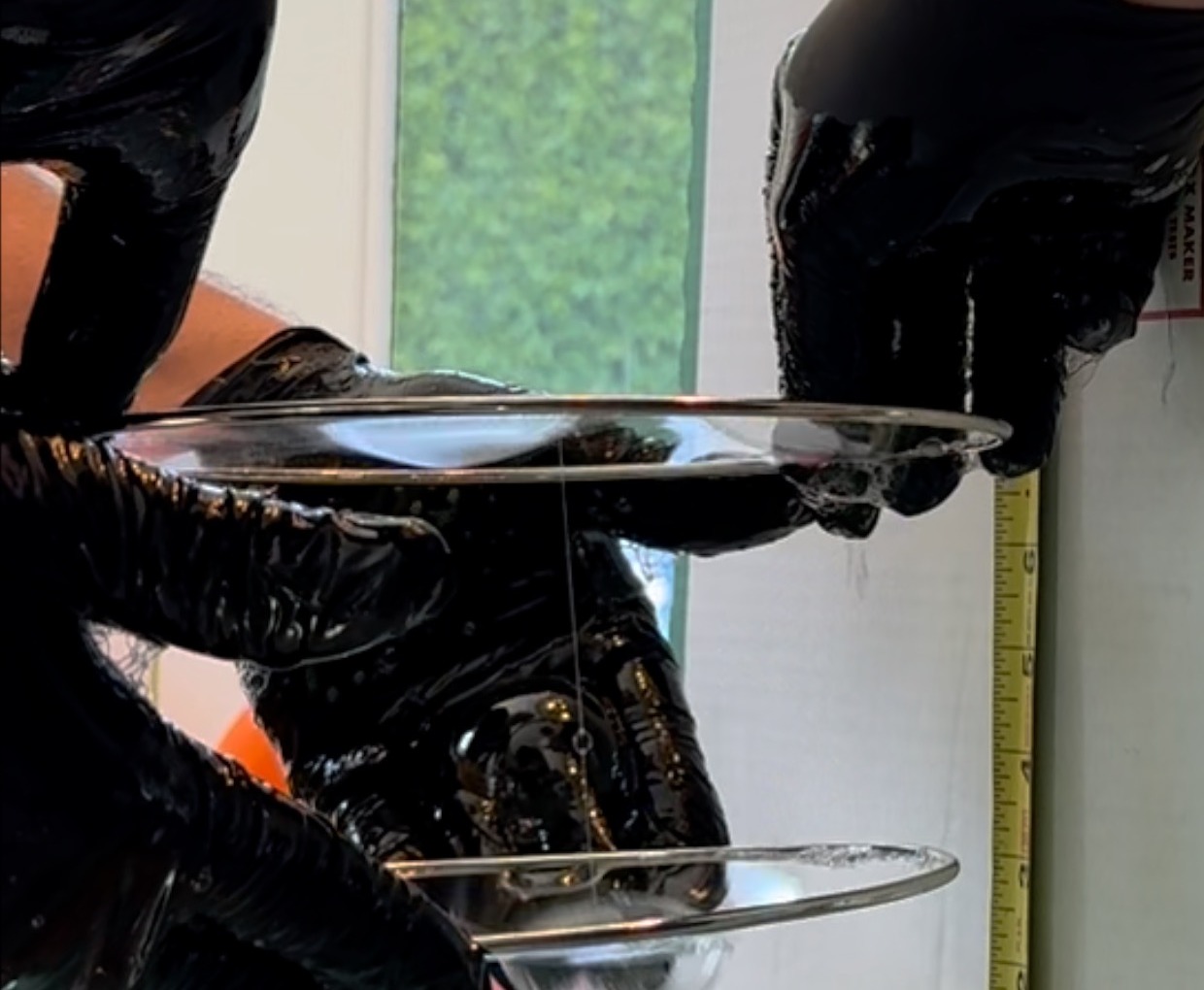

One bookkeeping note about that ending. The two within-rings disks that appeared after the tear were not the area ledger's doing: at 3.5 inches, the disks cost about 16 units more than the catenoid they replaced. They re-formed with help the ideal model does not count: wetting, contact-line physics, and the liquid carried on the wetted wire. The speed of the snap shapes the route the collapse takes, but speed is not an energy source and does not itself close the books. A tear does not walk down the landscape; it leaves the landscape, and what forms afterward is settled by wetter, messier physics. Three different deaths can look like the same pop; they're not. Route Three is where your own experiment will likely end because the energy to kill a soap film is easy in our busy world. That third death is what happened in these photographs: the catenoid still had protection left, but the material itself gave out. 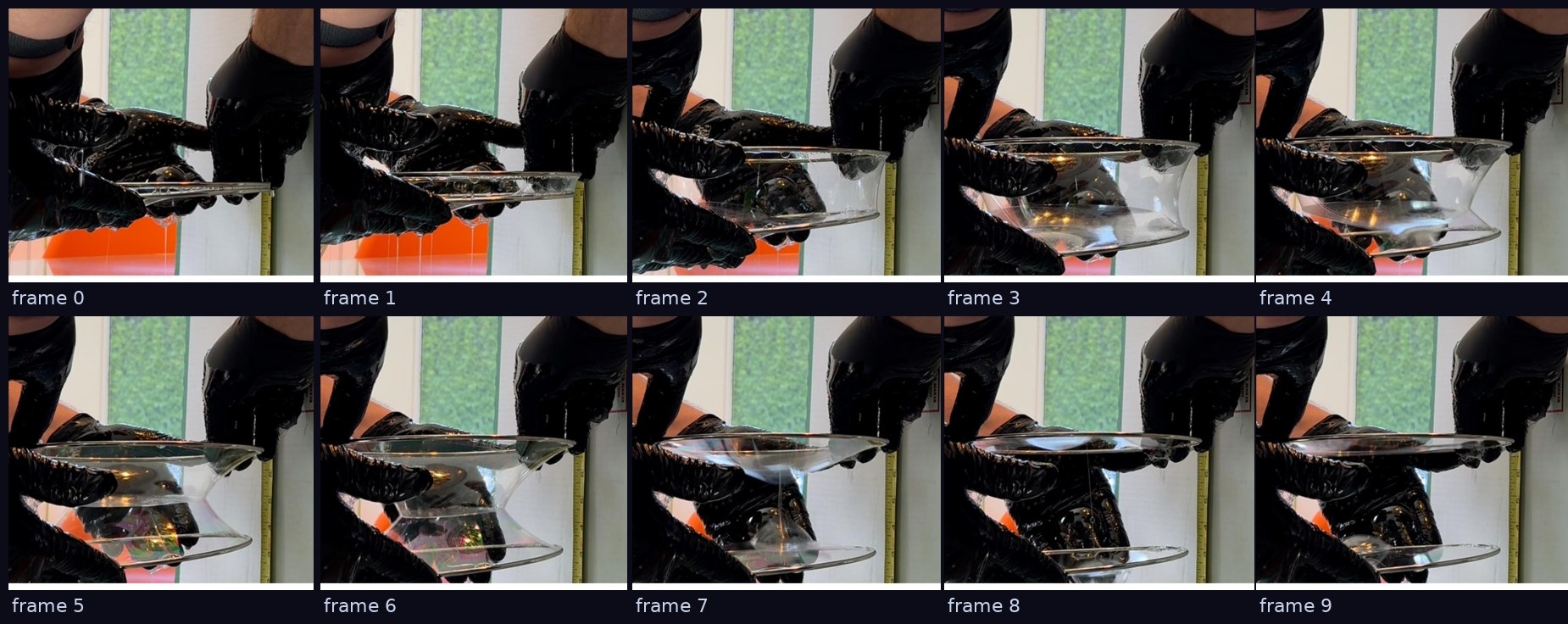
12
The foldThe merge of the slim-waisted catenoid's widening and the wide-waisted catenoid's slimming has a shape, and a name: the fold. At the final instant, the dip of the wide-waist and the ridge of the slim-waist do not crash into each other. They meet smoothly. The log flume that starts in a dip and then rises to a peak got pulled up by some mythical hand, and what the hand erased is the climb between dip and peak. Not the whole ride: the flume still rises behind the parked log toward wider waists, and still falls away past the crest toward narrower ones. The toll of going from dip to peak, therefore, is now zero; and from that spot forward, the ride runs only downhill. The protected place and the crest are now the same place: a ledge, protected on one side, open on the other. At its very last instant, the wide catenoid has become exposed on the narrowing side, where its protective climb has vanished. It now sits on a ledge: protected toward wider waists, open toward narrower ones. Its protection did not fail; the climb between them was erased. 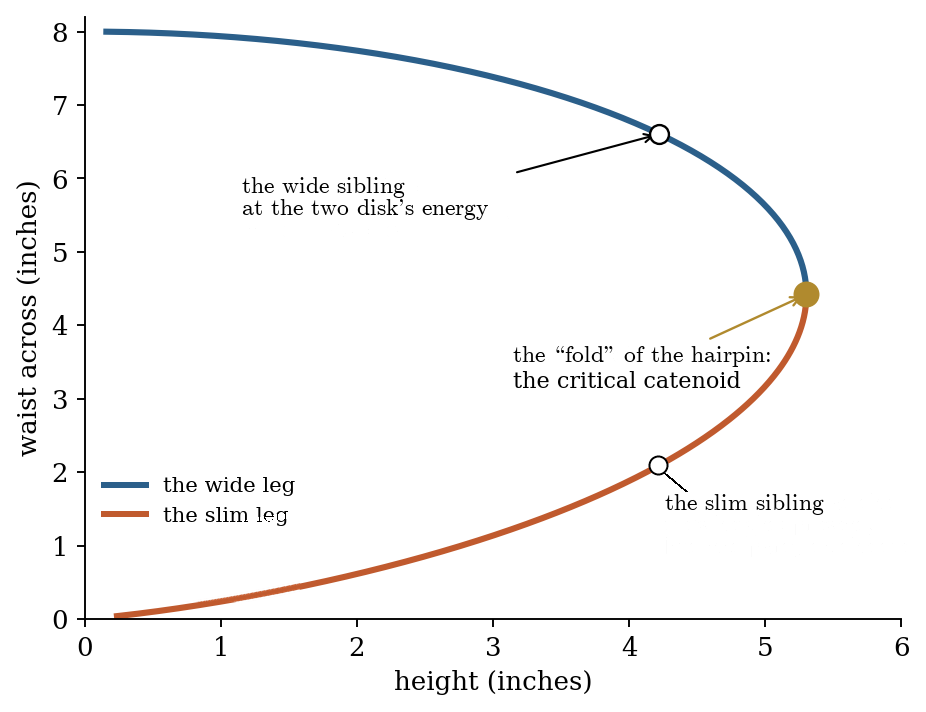
Mathematicians have a rather intuitive name for this kind of event: a saddle-node bifurcation. The node is the dip, the place a ball can rest. The saddle is the ridge, and the name is honest: a horse's saddle is low front-to-back, where the rider sits, and high side-to-side. The slim catenoid is exactly that kind of balance: a resting place only if you sit exactly on the brink. Bifurcation makes more sense in translation: bi, two, and furc, fork. Run the height dial one way and one shape forks into two, the dip and the saddle. Run it the other way, as our flume did, and the two meet in the middle and get folded together; hence, the fold. The word fold is exact, and the chart above shows why. Run the height along one direction and the waist across along the other, and mark every balancing catenoid as a dot. At each height before the deadline there are two dots: the wide waist and the slim waist. Connect all the dots and something surprising appears: they are not two separate curves. They are one curve, bent back on itself like a hairpin. The wide waists run along one leg, the slim waists along the other, and the two legs join at a single point: the turn of the hairpin, where wide and slim have become the same waist. That turn is the critical catenoid. The event is called a fold because the curve of all possible catenoids is, quite literally, folded. The math ends at the edge of the hairpin, like the height of the thrown ball ends at the height it's been thrown. This guide's landscape allows the soap film only one kind of move, a wider or narrower waist, and along that ride's route the slim catenoid is the crest of the ridge. Against almost every other disturbance it holds firm, as section 8 promised: low in most directions, high in one, a saddle. 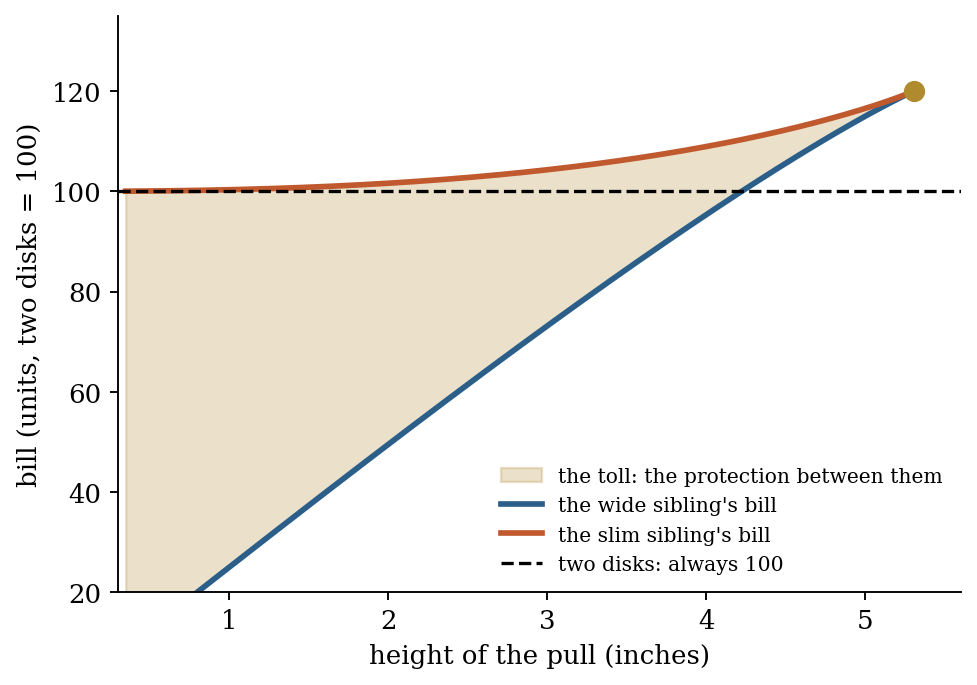
When the flume's climb flattens away and the fold arrives, the dip and peak meet, the end of the ride is upon us. Like a log flume at its peak, there is a lot of stored energy. The soap film when the fold comes carries roughly twenty units more energy than is needed for the two disks it is about to become. What happens to the excess energy in the catenoid it won't need as two disks? Think log flume. Once you get to the end, and it's time to go over the falls, you get screams (hopefully of joy), and all this pent up energy that gets released. In soap film terms, that surplus is available to emerge as the sharp little snap you hear, ripples racing across the surviving disks, a fine spray of droplets, and a share rubbed away as friction inside the liquid itself. The photographed rupture also throws droplets, although that soap film failed well before the mathematical fold. 13
Half a canSo there you have it. All this explanation covers everything so far in the soap film's biography. Every equation and explanation so far ran through the soap film's surface area: the bill, the toll, the whole landscape. The soap film never once had to stray from its surface to see what it enclosed. Cap the critical catenoid at both ends and draw the straight-walled can framed by the same rings. What fraction of that can does the capped hourglass enclose? Exactly half. 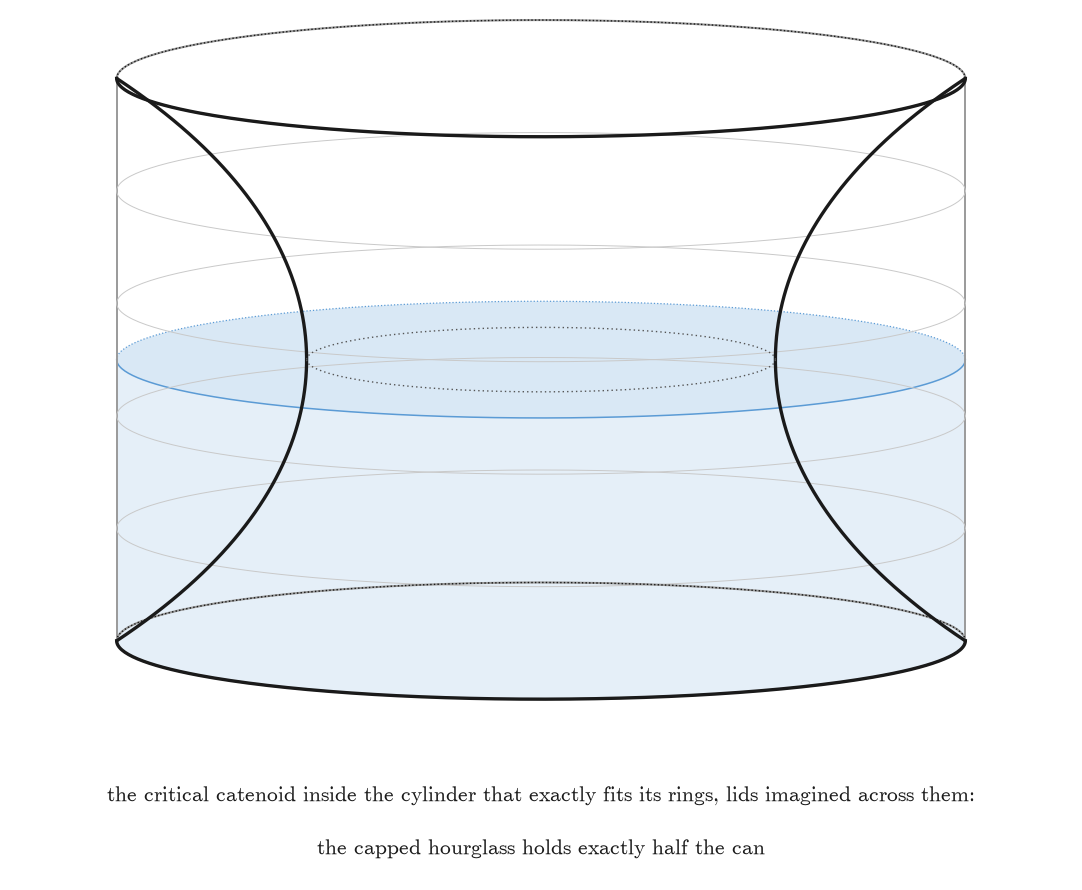
Not roughly half. Exactly half, as a mathematical identity.9 Here is the theorem as something you can pour. Take the can that snugly holds the last hourglass, ring wide and deadline tall. Pour into it exactly the water the capped hourglass holds. The waterline comes to rest at the exact middle of the can. Not roughly half. The midline. Nothing in the story so far had any obvious reason to produce that answer. The peak came from a race between growth rates. The pop came from a dip catching its own peak (ridge). Neither process mentioned volume. And the soap film itself has no reason to care about volume. Its middle is open. It traps no air. It has no pressure to satisfy (like so many bubbles), no volume to protect, and no inside to defend. Thinking about soap films as volumes is like trying to make them bubbles. They aren't. The half itself has a distinguished witness. Joseph Plateau, the soap-film pioneer this whole subject descends from, found the half-a-can fact; Lorenz Lindelöf put it in print in 1863, crediting Plateau, and Plateau even checked it by experiment with a catenoid of oil. Then the result slipped from view for a century and a half, because surface area is what the physics keeps pointing at: nothing in the classical soap-film problem calls for volume, and the log flume flattening mechanics work without it. What had gone unasked, as far as the literature search behind this result could determine, is the reverse question: whether filling exactly half the can happens only at the breaking point. That question becomes natural when you treat the catenoid as one member of a larger family of circle-to-line solids and ask how much of its can each member claims. 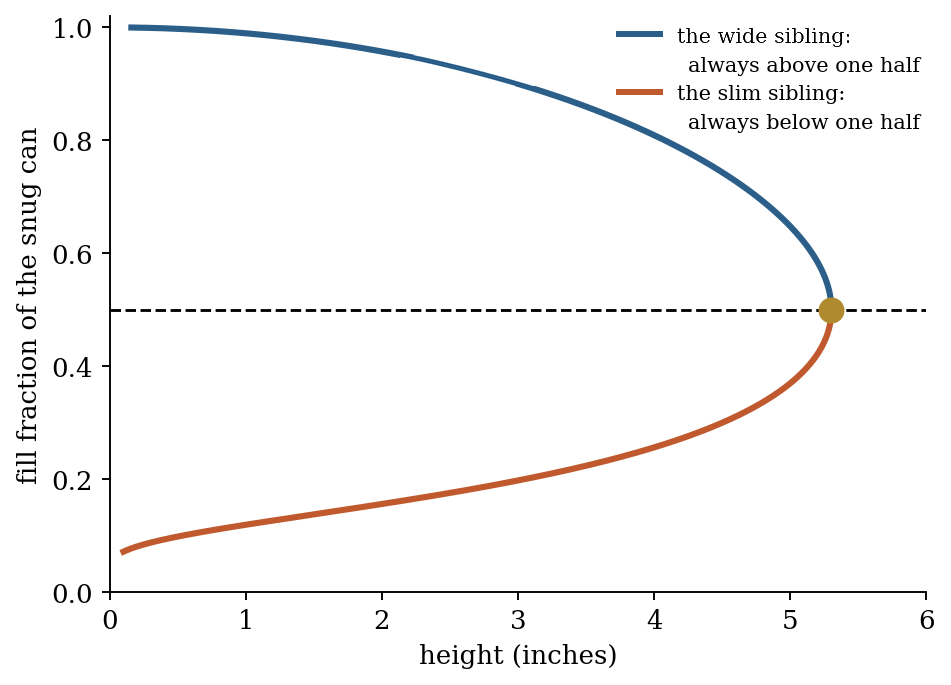
Ask the question anyway, and the ordinary can fill fraction turns out to have been falling the whole time: from nearly one full can at tiny heights steadily downward as the waist pinches. It crosses exactly one half at exactly the instant the toll hits zero. A mirror ledger has been running all along. The wide sibling always contributes more than half the can's volume, and the slim sibling always less. As the two converge, the two readings converge with them. At the fold there is only one catenoid left, one that, capped, fills exactly half its imagined can. The same equation that merges the siblings makes the final catenoid fill exactly half its imagined can. The breaking-point condition and the half-a-can condition are the same equation wearing two costumes. That is the theorem. 14
Try it yourselfUsing household items, you can see for yourself how this science of metaphors comes to life. Hold up a necklace between your hands and you'll find the catenary. Balance a coin on edge and see the inventory of ways a coin can land that most people don't think of. Find an expandable lawn chair and a ping pong ball, and see how the dip gets flattened on it being raised. Go to the Soap Film tab at skwedge.org and look at the numbers: three checks, none requiring trust. Divide the height by the waist across and you land exactly on the pinch. Double the indent, add the waist across, and you rebuild the ring's full width. Divide the necklace's sag by its span and you get the same number as the indent divided by the height. The Soap Film tab stages this whole guide as one interactive, in plain language with the necklace, the band, the chair, and the race all driven by a single slider. The Fold Explorer is the same engine as an instrument: the full 3D landscape, both rails, the fold point, and every cockpit indicator, from touching rings to the pop and beyond. That is the whole story in household objects. For readers who want to see the engine under the hood, the formal mechanics follow, with the same cast under their working names. Do-It-Yourself Instructions Kid-versions of bubble wand formula won't make a soap film strong enough to survive the pull between the wire rings. You need the professional bubble maker's version to make a soap film that works well to demonstrate the hollow hourglass catenoid. The wire rings used in the author's production were two 8-inch nickel-plated macrame hoops (about $4 each at the time of purchase) from a big craft store. Gelatin version, kitchen ingredients onlyDissolve a quarter teaspoon of unflavored gelatin in a cup of just-boiled water. Stir in a tablespoon of glycerin and 60 milliliters of dish detergent. Top up to one liter with warm water, and use slightly warm, since gelatin sets as it cools. Polyethylene Oxide versionTo one liter of warm water, add about 50 milliliters of professional-grade dish detergent and a scant half gram of a polyethylene oxide veterinary lubricant powder from veterinary and farm-supply stores (sold as J-Lube; the powder is polyethylene oxide blended with a sugar carrier, so measure the powder as sold). The powder clumps if it hits water directly, so first rub it into a spoonful of detergent, then whisk the slurry into the water and let it rest for an hour. The polymer needs time to uncoil, and the hydrated polymer is the extra trick that gives the soap film its unusual staying power. A few cautions: read the manufacturer's safety data sheet for the powder before handling it; avoid raising or breathing the powder's dust and keep it away from flame; wear eye protection while measuring; vacuum or gently sweep up any dry spill without raising dust, before water touches it, because the wet polymer makes floors extremely slippery; and let an adult handle the just-boiled water in the gelatin recipe. These quantities are working recipes, tuned by practice rather than measurement. For the build in motion, the giant-bubble community has filmed it a hundred ways: the Soap Bubble Wiki's polyethylene oxide page (soapbubble.fandom.com/wiki/PEO) is a detailed practical reference on the polymer, its mixing, and its storage, and NightHawkInLight's giant-bubble tutorial shows a whole rig built on video. To get the hourglass shape, you need both wire rings gooped with soap film and pressed together. In the author's video, you see two people wearing black gloves (soap film is messy), one holding the lower ring, one holding the upper ring. The key is keeping the rings level and in line: parallel to each other, flat with respect to gravity, one directly above the other. Creating the first bit of height between the top ring and the bottom ring is usually the hardest step. But once the soap film appears spanning the edges of the two wire rings, you're ready to lift higher. As you separate the rings more, the hourglass catenoid shape appears more and more. Keep separating and finally the soap film will give way and you'll see the catenoid collapse. In the author's video, you can see a nice dispersal of soap as it disappears. A note on giant bubbles (and the mall kind)The industrial-strength soap film we used to demonstrate the catenoid came from the world of professional bubble makers. A note about them: they do AMAZING things with bubbles. Nine-foot-long bubbles. Encasing a whole human inside a bubble. So if you're wondering why their bubbles don't pop where the catenoid pops, I wouldn't be surprised if that seems confusing. A couple of things:
For a really good example, look up videos of the bubble machine at Abt Electronics in Glenview, Illinois, where you pull a ring up and over yourself. Watch what happens when people stop pulling: a catenoid starts to form, then pop! The giant bubble carries its whole shape outward as it grows. The catenoid must keep stretching between two circles that remain stubbornly the same size. NotesEndnotes
The reader's guide ends here
That is the whole story in household objects. Stop here and you have lost nothing you were promised. What follows is the same story, told again in the language mathematicians use with one another. The same cast, under their working names. A glossary for the crossing
the dip · the wide sibling → stable catenoid the ridge · the slim sibling → unstable catenoid the table · two disks → Goldschmidt solution the toll · the protection → mountain-pass energy barrier the merge · the pop → saddle-node bifurcation (fold) Technical AppendixFormal mechanicsThis appendix restates the guide in standard terminology, with the governing equations. All worked dimensions use the guide's rig: eight-inch rings, R = 4 inches. Guide and figure terms map to formal ones as follows.
A.1 GeometryFor coaxial rings of common radius R separated by height h, a catenoid has profile r(z) = a cosh(z/a), with a cosh(h/2a) = R. (A.1)
Writing x = h/(2a), the boundary condition becomes h/R = 2x / cosh x. (A.2)
The fraction's structure carries the guide's central pedagogy: a linear numerator against an exponential denominator. The function rises while the numerator's relative growth 1/x exceeds the denominator's relative growth tanh x, and the peak condition 1/x = tanh x is equivalently coth x = x. (A.3)
The function rises from zero, attains its maximum 2λ ≈ 1.3255 at the unique positive root x* of coth x = x, with x* ≈ 1.19968 (OEIS A085984), and then decays. The constant λ ≈ 0.66274 is the Laplace limit constant (OEIS A033259), which originated in celestial mechanics as the largest orbital eccentricity for which the series solution of Kepler's equation converges; it appears here because both problems reduce to coth x = x. For h/R < 2λ, there are exactly two roots: the stable outer branch x ∈ (0, x*) and the unstable inner branch x ∈ (x*, ∞). At h/R = 2λ, the branches coalesce. Above it, no catenoid spans the rings. Throughout, critical catenoid means the catenoid at this equal-ring existence threshold; the free-boundary critical catenoid in a ball is a different object. A.2 Area and the energy landscapeThe catenoid's lateral area is A(x) = 2π a2 (x + sinh x cosh x), (A.4)
which in disk-indexed units, with two disks equal to 100, reads bill(x) = 100 (x sech2x + tanh x). (A.5)
At criticality, bill(x*) = 100 x* ≈ 119.97. The Goldschmidt configuration, in the enlarged admissible class allowing the spanning soap film to separate into two disks, has bill 100 at every height and becomes the global minimizer for h/R above approximately 1.0554, which is a height of 4.222 inches for R = 4 inches. Beyond that crossover, the stable catenoid is metastable. The landscape drawn in the guide is the constrained catenary family r(z) = w cosh(z/b), with b determined, for each trial waist w, by the boundary condition w cosh(h/2b) = R. The equilibrium catenoids are exactly the members with b = a, and the family's area functional exhibits the minimum at the stable root and the maximum at the unstable root. The barrier, or toll, is bill(slim) − bill(wide): approximately 52 units at h = 2 inches, 10 at the Goldschmidt tie, 3.3 at h = 4.8 inches, and 0 at criticality. A.3 Stability and the foldThe second variation of area about a catenoid changes sign with the Jacobi field criterion Ψ(x) = cosh x − x sinh x. (A.6)
It is positive on the outer branch, zero at x*, and negative on the inner branch. Within the one-parameter axisymmetric catenary-profile family used in this guide, enlarged to include separation into the Goldschmidt disks, the unstable catenoid is the mountain-pass crest on the least-energy route from the stable catenoid toward the separated state. Its single unstable direction is the axisymmetric neck-pinching mode. The coalescence at x* is a saddle-node bifurcation: in local normal form at the fold, the landscape slope dA/dw is proportional to (w − w*)2, with the two branches meeting tangentially and annihilating. 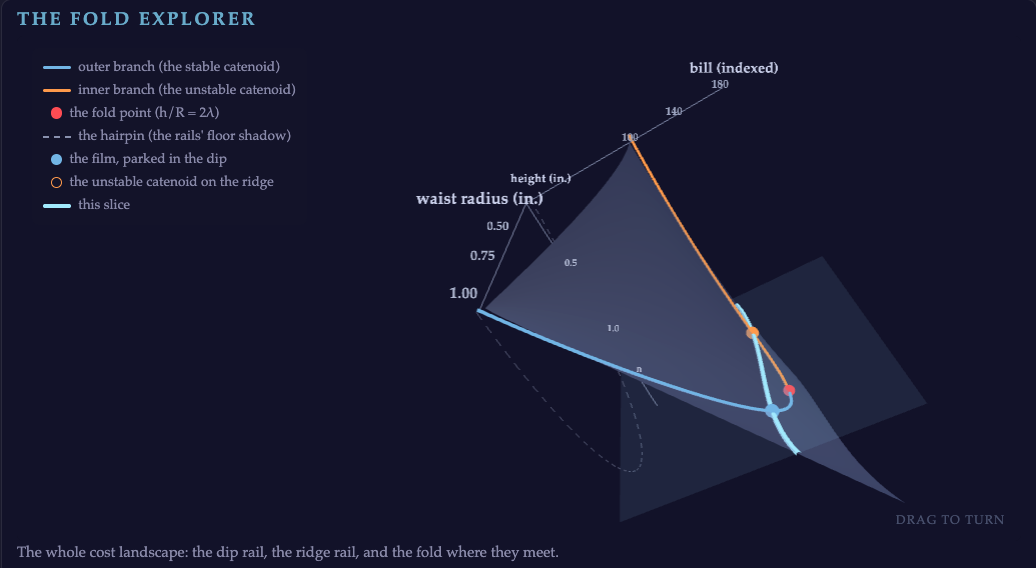
A.4 Equilibrium, stability, and protectionThese are three different questions. The first variation identifies equilibria: δE = 0, and both catenoid branches satisfy it. The second variation classifies their local stability: positive on the outer branch, negative along the inner branch's neck-pinching mode. The mountain-pass difference measures global protection: the minimum energetic cost, within the guide's axisymmetric catenary-profile family, of leaving the stable basin: the guide's toll. The wide and slim catenoids both satisfy the equilibrium condition; only the wide branch is locally stable, and only the wide branch possesses a positive protective toll. At the fold, the stable branch's lowest second-variation eigenvalue and its toll reach zero together. A.5 Stable versus metastable, preciselyThree regimes partition the stable branch, and the distinction is between local and global minimization. For h/R below the Goldschmidt crossover, approximately 1.0554, the stable catenoid is the global minimizer of area among admissible competitors: stable in the strongest sense, since no rearrangement of any size lowers the energy. Between the crossover and 2λ, the stable catenoid remains a strict local minimizer, with Ψ > 0 and positive second variation, but the Goldschmidt configuration is now the global minimizer. The catenoid is metastable: within the admissible landscape used here, the least-energy continuous route toward the lower Goldschmidt state passes through a barrier whose minimal crest is the unstable catenoid. Metastability is therefore a statement about the topology of the energy landscape, not about any weakening of the soap film itself. The local restoring forces at the dip are as real at bill 112 as at bill 49, only shallower. The barrier height sets the metastable lifetime in a qualified sense: with a specified stochastic-forcing model, a shrinking barrier generally makes escape more frequent, in the qualitative spirit of Kramers theory. No quantitative thermal-activation law is claimed here; for a macroscopic soap film, mechanical disturbances and material aging dominate ordinary thermal noise. At 2λ, the local minimum ceases to exist at all. The catenoid equilibrium passes from metastable to nonexistent without first becoming linearly unstable: the stable branch never acquires a negative eigenvalue; its lowest eigenvalue reaches zero exactly at the fold, and the branch terminates there. A.6 EnergeticsFor R = 4-inch rings (the eight-inch hoops used in the demonstrations) and an effective two-faced tension γeff = 2σ near 0.05 N/m (σ ≈ 0.025 N/m per interface), the Goldschmidt energy is approximately 3.24 millijoules, so one bill unit is approximately 32 microjoules. The barrier at h = 4.8 inches is then roughly 110 microjoules, small enough for ordinary air currents, vibration, and handling noise to matter. Laboratory soap films may collapse before criticality when mechanical disturbances overtop the shrinking barrier (noise-induced tipping), or may fail earlier still by material rupture: thinning and hole nucleation, a topology-changing failure the area landscape does not contain. The mathematical limit at 2λ is the pure bifurcation-induced tipping endpoint. Polymer-boosted soap films resist rupture longer through viscoelastic and drainage-stabilizing effects absent from the ideal minimal-surface model. The area surplus at the fold, bill(x*) − 100, is approximately 20 units, or 0.65 millijoules, and is available to be released through acoustic emission, capillary ripples, droplet ejection, and viscous dissipation. A.7 The volume identity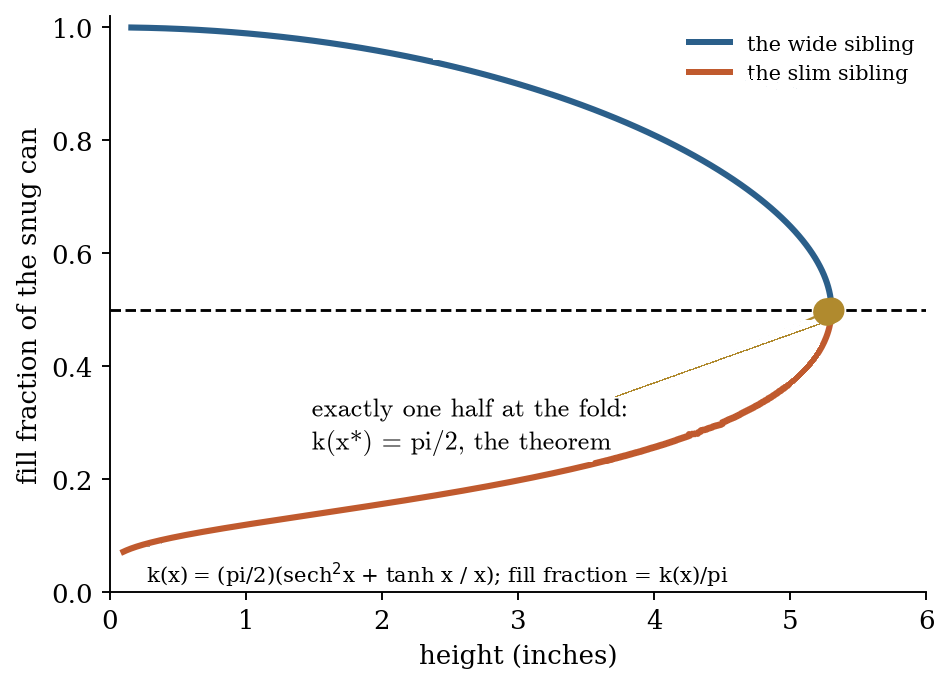
The catenoid's enclosed volume, normalized by R2h, is k(x) = (π/2)(sech2x + tanh x / x). (A.7)
The ordinary cylinder fill fraction is k(x)/π. The function k decreases strictly on the whole parameter range, from π (the cylindrical limit) toward zero; one derivative shows it, k′(x) = π(x − sinh x cosh x − 2x2 tanh x) / (2x2 cosh2x) < 0 for all x > 0, since sinh x cosh x > x and the last term is positive. It satisfies k(x*) = π/2 exactly: outer-branch catenoids always enclose more than half the circumscribing cylinder, inner-branch catenoids always less, and the two branches meet at exactly one half at the fold. The proof is one substitution: applying the hyperbolic Pythagorean identity sech2x = 1 − tanh2x, the condition k(x) = π/2 collapses to tanh x / x = tanh2x, which for x > 0 is coth x = x, the criticality condition itself. The volume plays no role in the catenoid's mechanics: open soap films carry no volume constraint. The half-cylinder identity at criticality was found by Plateau and first stated in print, with attribution to him, by Lindelöf (1863, p. 364); the area-centric literature that followed had no occasion to return to it, and the volume question arises naturally again within the circle-to-line taxonomy that motivates this series. What appears to be new in the companion paper is the converse (that the half-cylinder value is attained only at the critical parameter) together with the strict monotonicity of k. In this series' companion numerical study of dimensions four through seven, no comparable closed form appeared; among the dimensions tested, exact bisection is unique to dimension three. The hyperbolic identity itself is universal; what is specific to three dimensions is that the volume formula carries exactly the powers and coefficients that let the half-volume condition collapse through that identity to the criticality equation. A.8 The anatomy of the last balanceTake the family of trial catenary-profile surfaces, pinned to both rings, with the trial waist as the one dial, on the deadline page. Write the surface area as a function of the dial. At the last hourglass the first derivative is zero (it is a balance), and the second derivative is also zero (the wide and slim balances have merged there, and their opposite curvatures cancel at the meeting point). The verdict falls to the third derivative, which is not zero: 9.82 per inch when the dial is the waist radius, or 1.23 per inch when the dial is the waist across. A cubic level spot is one-sided: area rises toward wider waists and falls toward narrower ones, with no barrier at all on the narrow side. The last balance is a ledge, protected on one side, open on the other. A.9 The family this belongs toThe deadline event is a fold catastrophe, the simplest member of the classification of sudden changes worked out in the twentieth century. Its signatures are universal wherever it occurs: two balances that approach each other, merge, and annihilate; their separation closing like the square root of the amount remaining (here, the two waists sit apart by 4.52 inches times the square root of the inches left, with the inches left counted in inches); the protection between them dying like the three-halves power (here, 9.48 square inches times the inches left, counted in inches and raised to the 3/2; a constant distinct from the 9.82 above, in different units, their numerical nearness a coincidence); and, in any ordinary dynamical realization, the trembling around the stable balance slowing as the merger nears. The same fold, in other costumes, is the tipping point of a dynamical system, the bright curved line of light on the bottom of a coffee cup, and the sharp edge of a rainbow. A.10 The half, proved in three stepsStep one: for any hourglass catenoid, the enclosed volume divided by the snug can's volume reduces to a single expression in one number, x, the half-height divided by the waist radius: the ratio is (x + sinh x cosh x) divided by (2x cosh2 x). Step two: the deadline condition coth x = x, rearranged using cosh2 minus sinh2 equals one, says exactly that cosh2 x equals x2 over (x2 minus one). Step three: substitute, and the numerator becomes x3 over (x2 minus one) while the denominator becomes twice the same quantity. Everything cancels except one half. The proof is three lines, and the half arrives from nowhere except the deadline condition itself, which is the entire point. A.11 Protection in everyday unitsA soap film's energy is its area times the surface tension of the solution, doubled because a soap film has two faces. At a typical soap-solution tension of 25 millinewtons per meter, one square inch of soap-film area is 32 millionths of a joule, so one bill unit is about a sixtieth of a pinky lift, where a pinky lift is defined as raising a ten-gram little finger through two centimeters, about two thousandths of a joule. The soap film's protection, page by page on the 8-inch rig: 0.86 pinky at 2.0 inches of height, 0.36 at 3.5 (the photographed soap film died there of thinning, its 0.36 pinky of protection unbreached), 0.22 at 4.0, 0.17 at the tie, 0.05 at 4.8, one two-hundredth at 5.2, zero at the deadline. The pop's release is one third of a pinky. For scale against thermal jostling: even the smallest toll this guide prices, the 3 units guarding the 4.8-inch station, stands about ten million billion times taller than the molecular thermal scale of room-temperature air, so thermal activation over a barrier of that size is negligibly improbable in this model; real deaths belong to macroscopic disturbance and material thinning. (Rig note: these figures are 8-inch-rig-native; the website's 4-inch hoop uses its own unit energy and requires conversion.) Sources and companionsT. Anderson, "The Volume of the Critical Catenoid," The Mathematical Intelligencer, DOI 10.1007/s00283-026-10551-0. Companion analysis: "Why π/2?", 10.5281/zenodo.19238028. Series papers: Zenodo DOIs 10.5281/zenodo.18808911, 10.5281/zenodo.18809246, 10.5281/zenodo.18809289, 10.5281/zenodo.18809353, and 10.5281/zenodo.18809372. Linked OEIS sequences: A019669 (π/2), A033259 (the Laplace limit constant), A085984 (the root of coth x = x). Primary historical sources for the volume identity: J. Plateau, Statique expérimentale et théorique des liquides soumis aux seules forces moléculaires, Vol. I (1873), §89 item 6 and §90; L. Lindelöf, "Théorie des surfaces de révolution à courbure moyenne constante," Acta Societatis Scientiarum Fennicae 7 (1863), 345-372, identity and attribution at p. 364. Interactive models: the Soap Film page at skwedge.org/soap-film and the Fold Explorer at skwedge.org/fold-explorer, which verifies k(x*) = π/2 numerically on load. Guide written by Troy Anderson, ORCID 0009-0008-3983-974X. | ||||||||||||||||||||||